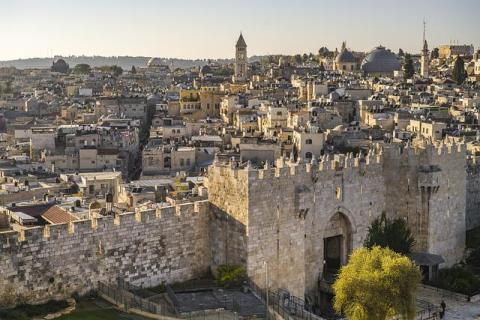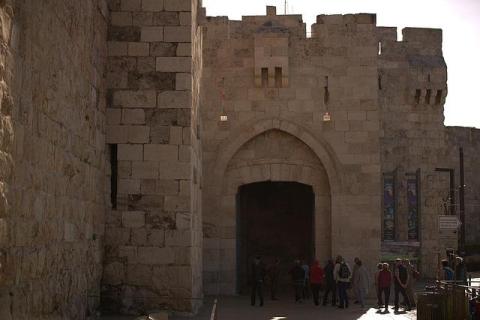

Jaffa Gate to Damascus Gate - Old City Wall, lookout point.
Every image of the Old City of Jerusalem, with its rising steeples and domes, is dominated by the fortress-like walls that surround its four quarters. Religious and historical texts refer to defensive walls surrounding the city in some form or another since ancient times. The walls that standing today were built during the 16th century by Ottoman Sultan Suleiman the Magnificent. The walls run a length of over 4,000 meters and stand at an average of 12 meters high. Along the wall are 34 watchtowers and seven main gates, six of them from the 16th century construction, with New Gate added later in the 19th century. Along with the Old City itself, the walls were added to the UNESCO World Heritage Site list in 1980s.
Although the shape and scope of the walls of the Old City has shifted throughout time, there are references to a settlement with defensive walls on what would become Jerusalem as far back as the 14th century BCE. According to Jewish tradition fortification walls were built during the time of the first temple and stood until the destruction of the city by Nebuchadnezzar of Babylon in 587 BCE. The walls then went through periods of destruction and reconstruction throughout history from the Romans to the Crusaders. It was between 1537 and 1541 under the leadership of Ottoman Sultan Suleiman the Magnificent that the walls seen today were finally constructed on the remains of these more ancient remains. During the British Mandate period in the early 20th century, the walls were cleaned and restored and the addition of the ‘green belt’ area surrounding parts of the wall’s exterior was added.
Visitors to the Old City of Jerusalem have the unique opportunity to walk along these walls and take in the sights of Jerusalem from atop the fortress. Tickets for the Ramparts Walk are available from the ticket office near Jaffa Gate and from there travelers can set out from Jaffa Gate along two routes – the northern or the southern route. The northern route follows the Christian and Muslim Quarters, passing New Gate, Damascus Gate, Herod’s Gate and Lions Gate. The southern route is shorter and takes visitors by the Armenian Quarter before ending in the Jewish Quarter, passing over Zion Gate. From the walls, visitors can get a different perspective on the sites of the Old City and take in the amazing views of the areas surrounding the walls.